Home / Guide
Guide Updated September 2026
What Is Small Parcel Shipping? The Complete Guide
Small parcel shipping, also called small package shipping or just parcel shipping, is how nearly every online order reaches a doorstep. It is also one of the largest controllable costs for any business that ships physical products. This guide explains how small parcel shipping works, what it costs, how the major carriers compare, and how to pay less for it.
By Timur Eligulashvili, founder of SmallParcel.com
20+ years in parcel: Echo, LSO, uShip, ShippingEasy. · 33 min read
Contents
- 1. What Is Small Parcel Shipping?
- 2. How Does Small Parcel Shipping Work?
- 3. Small Parcel Size and Weight Limits
- 4. Small Parcel vs. Freight (LTL)
- 5. How Much Does Small Parcel Shipping Cost?
- 6. Dimensional Weight Explained
- 7. Small Parcel Surcharges
- 8. UPS vs. FedEx vs. USPS
- 9. Regional and Alternative Carriers
- 10. Cheapest Way to Ship Small Packages
- 11. How to Reduce Small Parcel Shipping Costs
- 12. International Small Parcel Shipping
- 13. FAQ
- 14. Get a Free Savings Report
- 15. Sources and Methodology
What changed in 2026. USPS cut its dimensional-weight divisor from 166 to 139, effective July 12, 2026, and started rounding every fractional inch up to the next whole inch. USPS also added a temporary 8% price increase (widely called a fuel surcharge) on Priority Mail Express, Priority Mail, Ground Advantage, and Parcel Select, running April 26, 2026 through January 17, 2027. Since January 2026, UPS and FedEx both added cubic-volume triggers for Additional Handling (over 10,368 cubic inches) and Large Package/Oversize (over 17,280 cubic inches or 110 pounds). All three carriers now round each measured dimension up to the next whole inch: UPS and FedEx since August 18, 2025, USPS since July 12, 2026.
1. What Is Small Parcel Shipping?
Small parcel shipping is the movement of individual packages, generally weighing up to 150 pounds, through carrier networks built for speed and volume. Freight, by contrast, moves palletized goods on trucks.
Every parcel travels as its own unit. It is picked up, scanned, sorted by machines, loaded onto trucks or planes, sorted again, and delivered to a door. This parcel shipping system is designed to handle millions of these units a day at a low cost per package.
The boundaries that define small parcel are set by the carriers. UPS and FedEx accept packages up to 150 pounds, up to 108 inches long, and up to 165 inches in combined length plus girth. USPS caps its parcel services at 70 pounds and 130 inches in length plus girth, though some USPS services are tighter. “Small parcel” is an industry category, not a literal size: a 100-pound box is still a parcel as long as it stays inside these limits.
Packages inside these limits generally qualify for parcel service, though packages well inside them can still draw large surcharges when they trip size or weight triggers (see section 7). Anything beyond them needs a different mode.
Three groups of shippers use small parcel shipping most. E-commerce businesses ship individual orders to consumers. B2B companies ship replenishment orders, parts, and samples to other businesses. And every seller with an online presence ships returns back through the same networks, a flow large enough to deserve its own planning.
If your shipments are small, light, and frequent, parcel is almost always the right answer. When shipments get heavy, palletized, or oversized, the comparison shifts to freight, which is covered in section 4.
2. How Does Small Parcel Shipping Work?
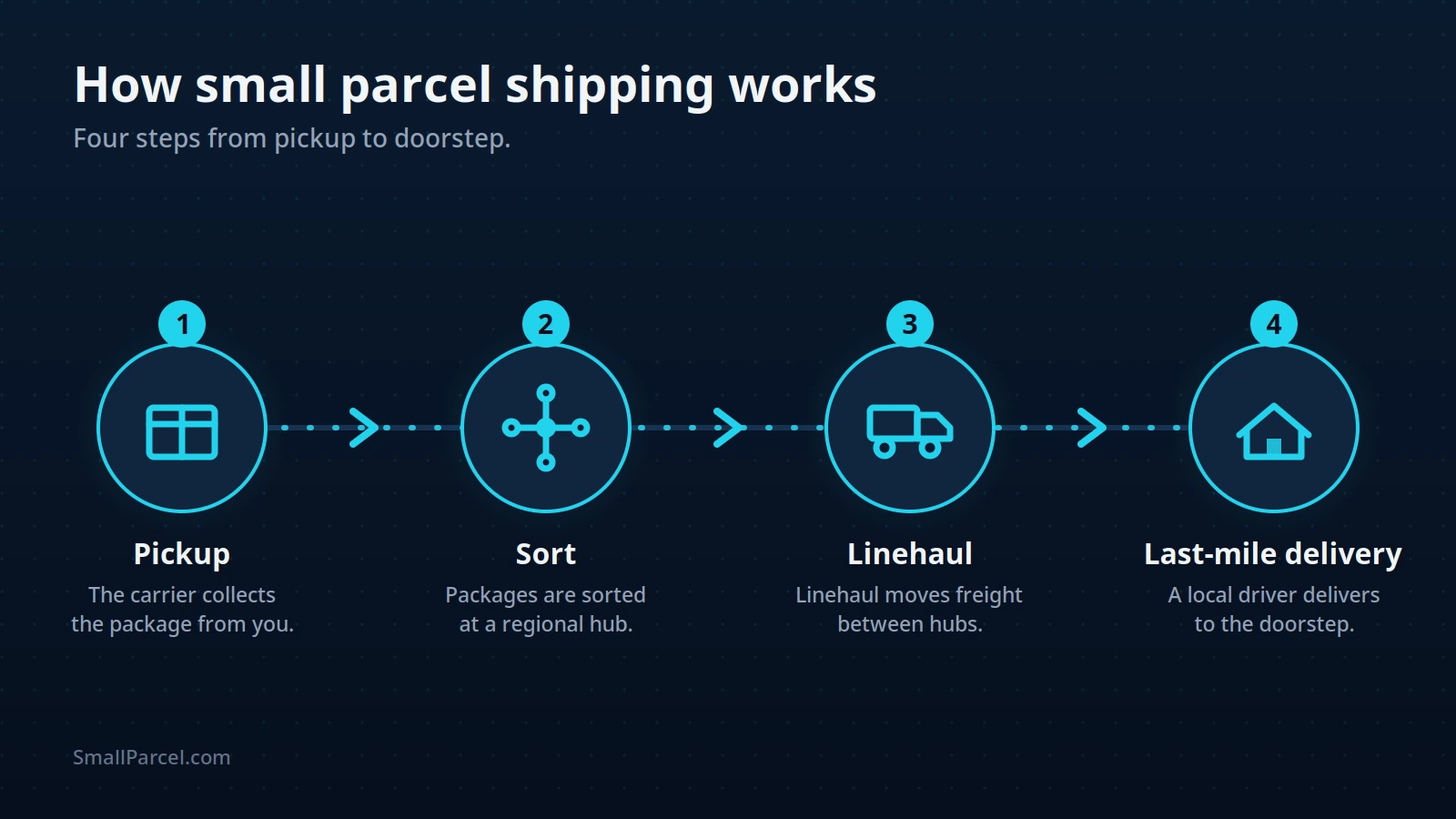
A parcel moves through a hub-and-spoke network: local facilities collect packages, regional hubs sort them, and linehaul trucks or planes move them between hubs. The typical journey looks like this:
- Pickup or drop-off. The carrier collects the package from your location, or you drop it at a carrier facility or retail point.
- Origin scan and sort. The package is weighed, measured, and scanned at a local facility, then sorted by destination.
- Linehaul. Sorted packages travel by ground trailer or aircraft to a regional hub near the destination.
- Destination sort. The hub sorts packages onto local delivery routes.
- Last-mile delivery. A driver delivers the package to the door.
Carriers sell the same network at several speeds. The service levels that matter most:
| Service | Best for | Typical transit |
|---|---|---|
| UPS Ground, FedEx Ground / Home Delivery | Non-urgent packages up to 150 lbs | 1 to 5 business days |
| UPS and FedEx express (overnight, 2-day, 3-day) | Time-definite deliveries | 1 to 3 business days |
| UPS Ground Saver | Lightweight, non-urgent residential packages | UPS Ground plus 1 to 2 days |
| FedEx Ground Economy | Lightweight residential packages for account holders | 2 to 7 business days |
| USPS Ground Advantage | Packages up to 70 lbs, including PO boxes | 2 to 5 business days |
| USPS Priority Mail | Faster delivery up to 70 lbs, flat-rate options | 1 to 3 business days |
Two economy services deserve a closer look because shippers confuse them often. UPS Ground Saver (formerly SurePost) is built for lightweight residential deliveries, ideally under 10 pounds; final-mile delivery is handled by UPS or the U.S. Postal Service depending on the destination. FedEx Ground Economy (formerly SmartPost) is a contract-only service for residential deliveries, capped at 70 pounds and 130 inches in length plus girth, with final-mile delivery primarily by FedEx. It carries no money-back guarantee.
Weekend delivery varies by carrier and service. UPS and FedEx deliver on Saturdays for most services, and FedEx Home Delivery runs on Sundays in many areas. USPS delivers on Saturdays at no extra charge as part of its normal schedule.
Returns move through the same networks in reverse. Both UPS and FedEx offer returns products, and planning the return label, the drop-off or pickup option, and who pays for return shipping belongs in the original shipping strategy, not as an afterthought.
For a look at how experienced operators design these networks, see the Logistics Remix interview with Justin Cramer on how shippers design multi-carrier networks.
3. Small Parcel Size and Weight Limits
The carrier limits are the hard edges of small parcel shipping. Stay inside them and your package moves normally. Cross them and the shipment is not accepted, or it draws a steep penalty if it is found in the system.
| Carrier | Max weight | Max length | Max length plus girth |
|---|---|---|---|
| UPS | 150 lbs | 108 in | 165 in |
| FedEx | 150 lbs | 108 in | 165 in |
| USPS | 70 lbs | Service-specific | 130 in |
A few notes on the table. These are general maximums; some services are tighter. FedEx Ground Economy, the contract residential service, follows the 70-pound and 130-inch caps rather than the standard FedEx limits. At USPS, Priority Mail caps length plus girth at 108 inches while Ground Advantage allows 130 inches. Length plus girth = longest side + (2 × width) + (2 × height), which is how carriers measure bulky boxes.
Packages that exceed the limits are outside the parcel system. UPS applies an Over Maximum Limits charge and FedEx a Ground Unauthorized Package Charge to packages found in their networks beyond the limits, and both penalties run into four figures per package. The practical rule is simple: measure and weigh before you ship, and if a shipment is approaching the maximums, price it as freight too. Enter your box dimensions in the parcel surcharge checker to see which size and weight thresholds your package triggers.
4. Small Parcel vs. Freight (LTL)
Freight, specifically less-than-truckload (LTL), is the alternative when shipments outgrow parcel. In LTL, multiple shippers’ palletized freight shares one trailer. The decision between parcel and LTL comes down to weight, handling, and cost structure.
| Factor | Small parcel | LTL freight |
|---|---|---|
| Shipment form | Individual boxes | Pallets |
| Typical weight break | Up to 150 lbs per package | Above 150 lbs, or full pallets |
| Cost structure | Per package, zone and weight based | Per hundredweight, class and distance based |
| Speed | 1 to 5 business days ground | 2 to 5 business days typical |
| Handling | Automated sort, conveyor systems | Forklifts, manual loading |
| Tracking | Piece-level tracking standard | Shipment-level tracking |
| Special services | Limited | Liftgate, delivery appointments, inside delivery |
The 150-pound mark is the practical decision line. A shipment over 150 pounds, a full pallet (roughly 4 feet by 4 feet), or several heavy boxes going to one customer is worth comparing against LTL rather than pricing as a set of parcels. Dense, heavy products and recurring B2B deliveries to the same locations are classic LTL freight.
A quick decision guide:
- One box under 150 pounds → price it as parcel.
- Multiple heavy boxes going to one place → compare parcel and LTL.
- Palletized shipment → price it as LTL.
- Liftgate or a delivery appointment needed → lean LTL.
LTL also offers services parcel networks do not, such as liftgate delivery for locations without a dock, scheduled delivery appointments, and inside delivery. If the receiving location needs any of those, LTL is often the better fit.
5. How Much Does Small Parcel Shipping Cost?
What you actually pay for a parcel shipment is:
transportation charge + fuel + accessorials, adjusted by contract discounts, minimum charges, and incentives.
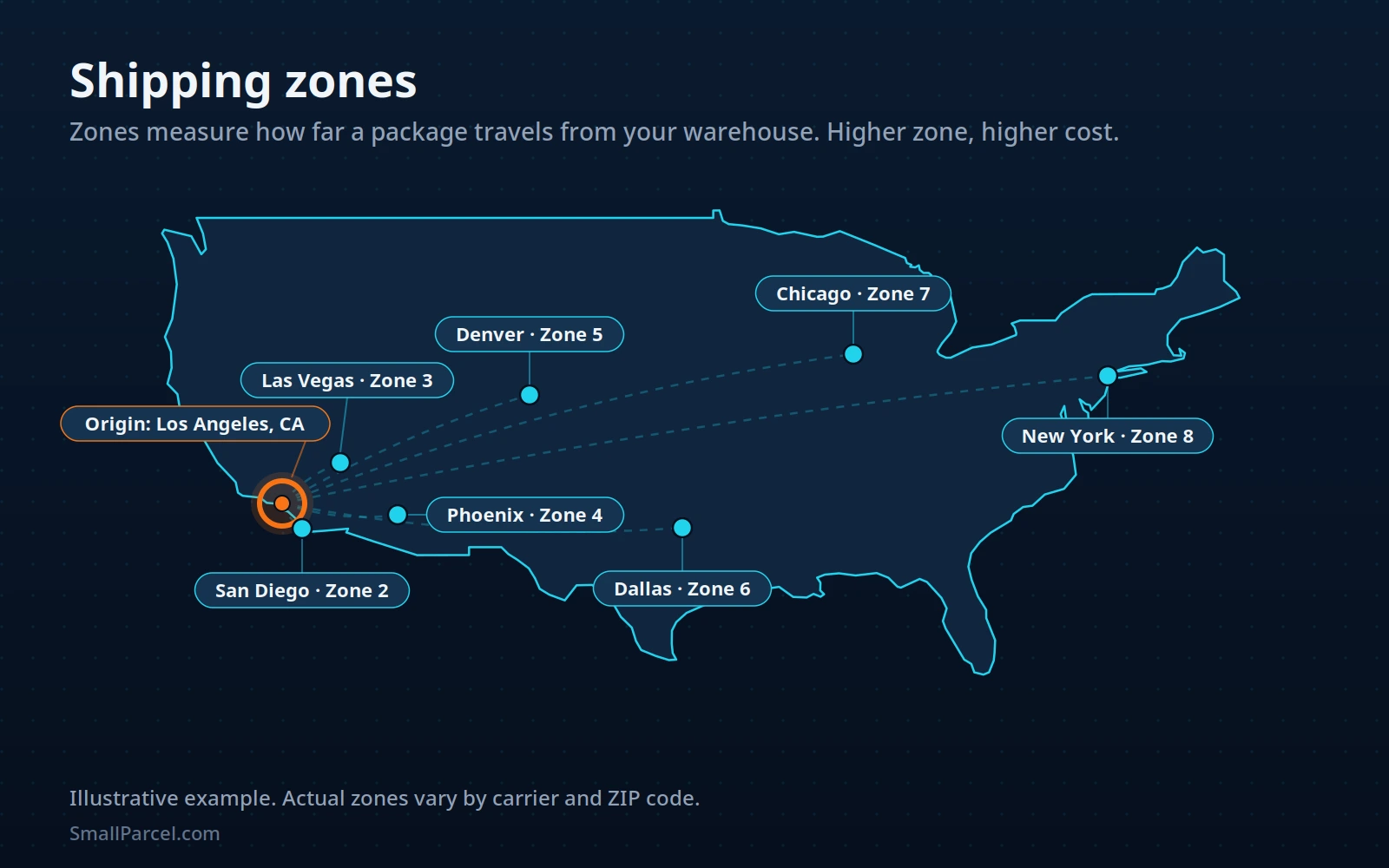
The transportation charge depends on the package weight (or dimensional weight, covered in section 6), the service level, and the zone. Zones measure how far a package travels from your warehouse. UPS and FedEx number their domestic zones 2 through 8; USPS uses zones 1 through 9. Zones are measured from origin ZIP code to destination ZIP code, not drawn as fixed regions on a map, so two customers in the same state can sit in different zones. Higher zone means higher cost and longer ground transit: a Zone 2 ground shipment often arrives in a day or two, while a Zone 8 shipment can take most of a week.
Fuel is a weekly percentage added to the transportation charge (see section 7).
Accessorial fees are the per-package charges for everything beyond basic transportation: residential delivery, delivery-area coverage, extra handling for heavy or awkward packages, address corrections, and more. Individually they look small. Across a week of shipments, they reshape the invoice. Section 7 breaks down each of these fees.
How a published rate becomes your net cost.
- Published rate for service, weight, and zone.
- Apply your contract discount and any earned incentives.
- Check the minimum charge. If the discounted rate falls below it, the minimum applies.
- Add accessorials (residential, DAS, and so on), with any negotiated discounts.
- Add fuel as a percentage of the transportation charge and most accessorials.
Carriers also announce general rate increases each year, usually taking effect in late December or January. Expect the base rate tables to move annually and plan budgets accordingly.
What shippers get wrong (Nate Skiver, LPF Spend Management): “The 5.9% general rate increase is an average across every customer, and almost no one is the average. Pivot your volume by billable weight and zone, apply the new rates, and compare against last year’s rates on the same volume to find your real increase.”
6. Dimensional Weight Explained
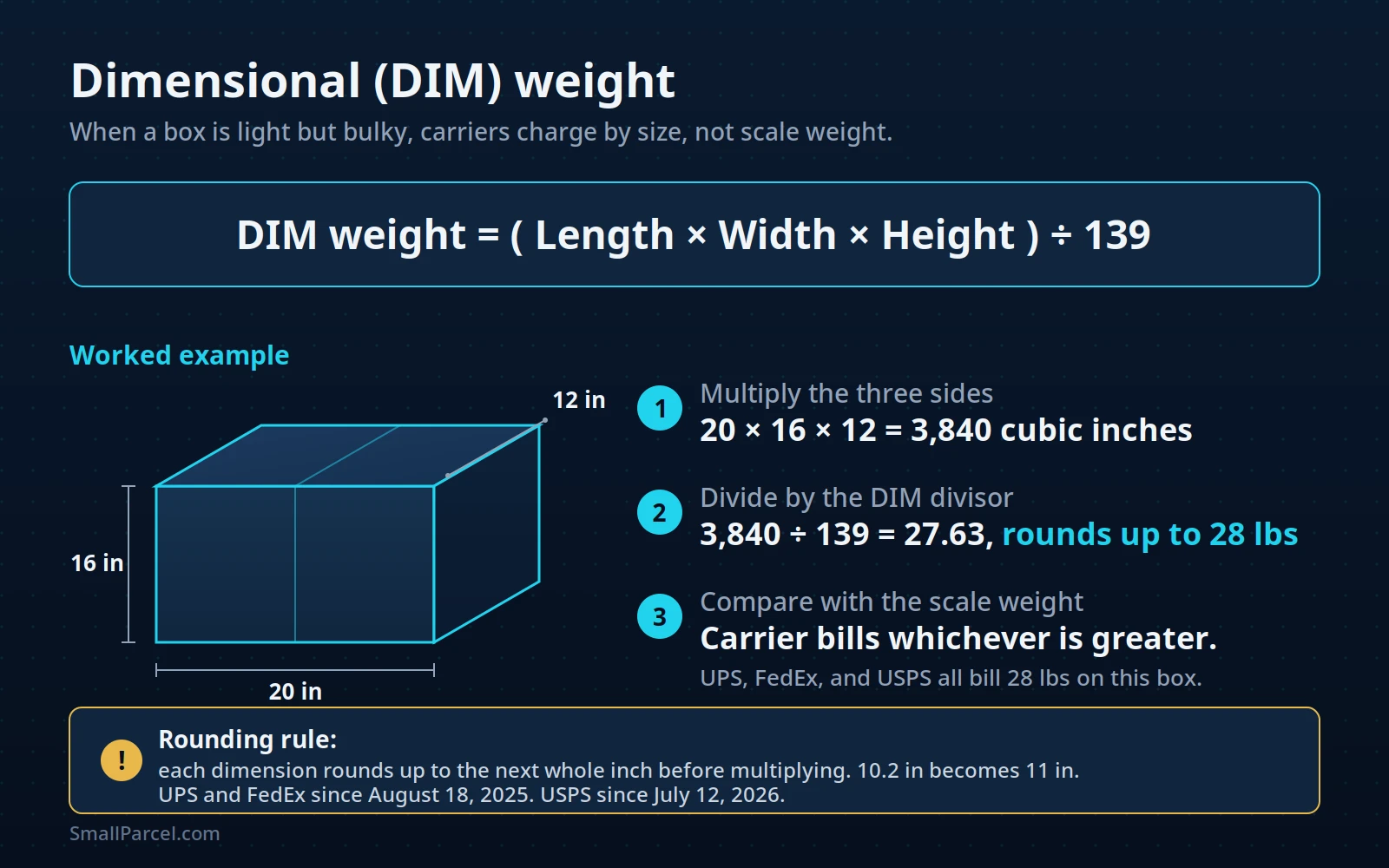
Carriers charge for the space a package occupies, not just its weight, because trucks run out of room before they run out of weight capacity. Dimensional (DIM) weight converts a box’s volume into a billable weight. The formula is simple:
DIM weight = (Length × Width × Height) ÷ DIM divisor
The carrier bills whichever is greater: the DIM weight or the actual scale weight. Billable weight rounds up to the next whole pound.
All three now use 139 on most commercial rates, but they do not apply it the same way:
| Carrier | DIM divisor | When DIM applies |
|---|---|---|
| UPS | 139 on daily and contract rates; 166 on retail rates | No cubic-foot minimum |
| FedEx | 139 | No cubic-foot minimum |
| USPS | 139 since July 12, 2026 (was 166) | Only above one cubic foot (1,728 in³) |
Two details in the calculation catch shippers off guard:
- Round each dimension up first. A box measuring 10.1 × 8.2 × 5.3 inches becomes 11 × 9 × 6 before any other math. UPS and FedEx have rounded every fractional inch up since August 18, 2025; USPS rounds up since July 12, 2026. The rounding happens on the dimensions, before multiplying.
- The one-cubic-foot floor is a USPS-only rule. USPS applies DIM weight only above 1,728 cubic inches. UPS and FedEx do not use USPS’s one-cubic-foot threshold.
A worked example: a 20 × 16 × 12 inch box holds 3,840 cubic inches, which is over one cubic foot, so DIM weight applies on all three carriers. Divided by 139, the DIM weight is 27.63 pounds, which rounds up to a 28-pound billable weight. If the product inside weighs 12 pounds, the carrier bills 28 pounds.
DIM weight bites hardest on big, light boxes: pillows, apparel, and oversized packaging can bill at several times their actual weight. The defense is packaging discipline. Use the smallest box that protects the product, consider multi-depth boxes that fold down to fit, and audit your most-shipped SKUs for air. High-volume shippers can sometimes negotiate a higher divisor as part of a carrier agreement, which is worth raising at the negotiating table.
7. Small Parcel Surcharges: The Fees That Inflate Your Bill
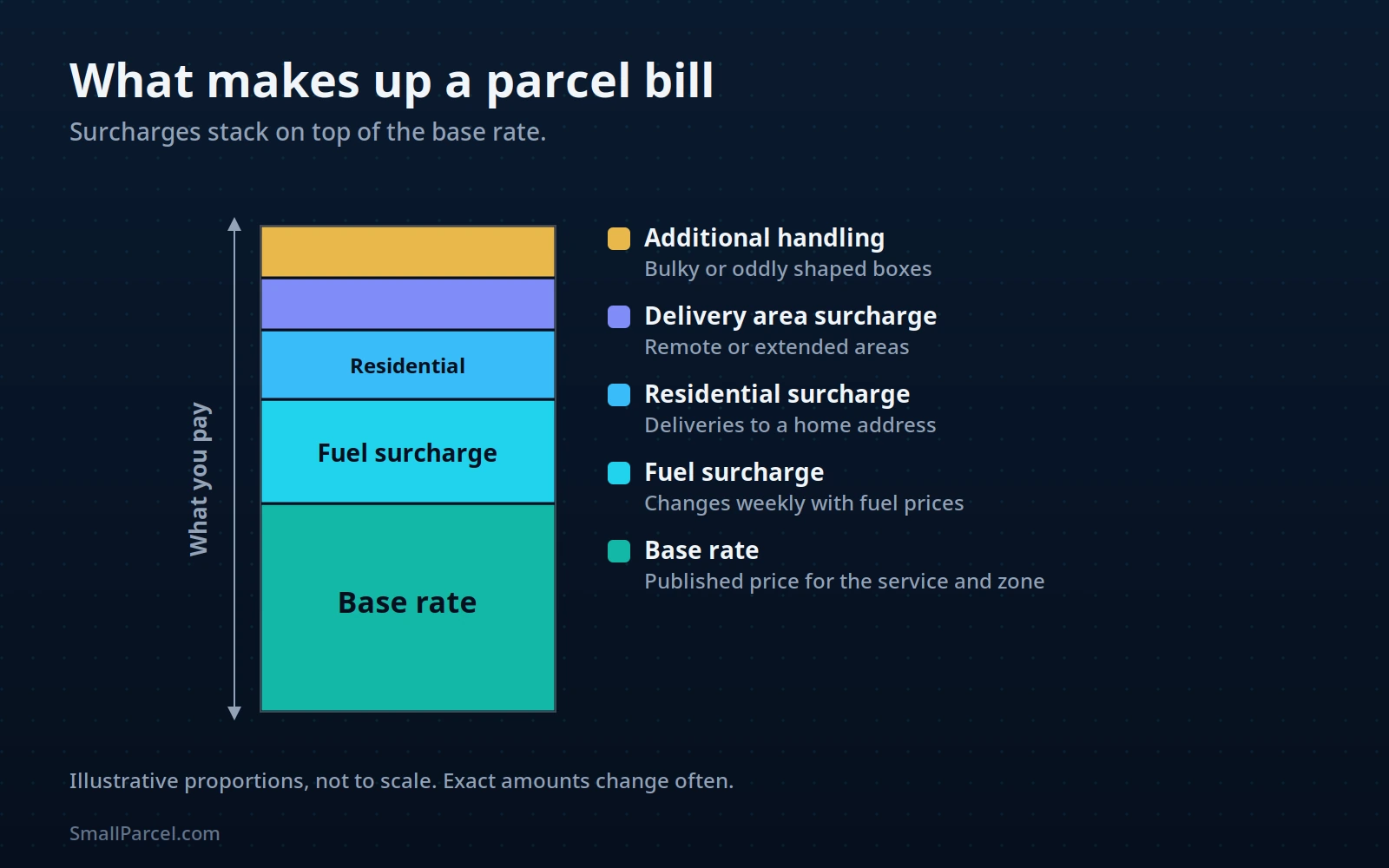
Base rates are only the starting price. In the parcel invoices we have reviewed over the last 3 years, covering millions of packages, surcharges average 35 to 50 percent on top of base rates, depending on destination mix and package characteristics. Carriers call these fees accessorial charges. Each one looks small on its own, so most shippers underestimate them. Across hundreds or thousands of packages a week, they reshape the total bill. Here is where the money goes.
| Surcharge | What triggers it | Typical size |
|---|---|---|
| Fuel | Every shipment. A weekly percentage of transportation charges | Often the largest single surcharge |
| Residential | Delivery to a home address | A few dollars per package |
| Delivery area (DAS) | ZIP codes outside the standard service area | A few dollars per package, and it stacks with residential |
| Remote area | Remote ZIP codes, including parts of Alaska and Hawaii | Tens of dollars per package |
| Additional handling | Heavy, oversized, or awkwardly packed items | Tens of dollars per package |
| Large package (UPS) / Oversize (FedEx) | Very large packages | Hundreds of dollars per package |
| Address correction | The carrier fixes a bad address | Tens of dollars per package |
| Demand (peak season) | Holiday-season volume | A few dollars per package, more for oversized items |
| Over maximum / unauthorized | Packages beyond the carrier’s limits | Four figures per package |
Fuel Surcharges
A fuel surcharge is a weekly percentage added to the base rate. The percentage follows published fuel price indexes and is recalculated every week. It applies to most charges on the invoice, not just transportation. On ground shipments, the percentage commonly runs 20 percent or more. Air percentages run higher. Because it changes weekly, no printed rate guide stays current. Check the carrier’s fuel page before you estimate costs.
Residential and Delivery Area Surcharges
A residential surcharge is a per-package fee on deliveries to home addresses. It is separate from the base rate, and nearly every residential package incurs it.
A delivery area surcharge (DAS) is an additional fee for ZIP codes outside the carrier’s standard service area, such as rural towns and remote suburbs. It stacks on top of the base rate, and on top of the residential fee. A residential package in a DAS ZIP incurs both charges at once. That stacking is one of the most common sources of invoice shock.
Most address lists contain some DAS ZIPs. If you have not checked yours, do it. A small share of orders to these zones adds up fast.
Remote Area Surcharges
Remote addresses sit one step beyond the standard delivery area, and the fee jumps accordingly. UPS gives them their own surcharge with its own name: the Remote Area Surcharge, which applies to certain ZIP codes in Alaska, Hawaii, and the 48 contiguous states. UPS publishes the ZIP list, so check whether your customers are on it.
FedEx handles remote addresses inside its Delivery Area Surcharge, under names like “Remote Commercial” and “Remote Residential,” plus separate Alaska and Hawaii lines. Either way, expect tens of dollars per package, with Alaska the steepest of the three.
Size and Weight Triggers
Surcharges for large and heavy packages are triggered by exact measurements. These are the ones to memorize, because an inch or a pound is often the difference between a standard shipment and a fee worth hundreds of dollars.
Size triggers (dimensions, girth, cubic volume, packaging):
| Fee | UPS trigger | FedEx trigger |
|---|---|---|
| Additional handling | Longest side over 48 in; second-longest side over 30 in; length plus girth over 105 in; problem packaging (tires, tubes, shrink wrap, non-corrugated containers); since January 26, 2026, cubic volume over 10,368 in³ | Longest side over 48 in; second-longest side over 30 in; length plus girth over 105 in; packaging not fully encased in an outer container, metal/wood/hard plastic, or cylindrical (tubes, drums, pails, barrels); metal, plastic, or cloth banding; since January 12, 2026, cubic volume over 10,368 in³ |
| Large package (UPS) / Oversize (FedEx) | “Large Package”: length plus girth over 130 in (up to 165 in), or length over 96 in; since January 26, 2026, cubic volume over 17,280 in³ or actual weight over 110 lbs | “Oversize”: length over 96 in, or length plus girth over 130 in; since January 12, 2026, cubic volume over 17,280 in³ or actual weight over 110 lbs |
Weight triggers (pounds, minimum billable weights, maximums):
| Fee | UPS | FedEx |
|---|---|---|
| Additional handling (weight) | Actual weight over 50 lbs (domestic) | Over 50 lbs, U.S. domestic Package Services; over 55 lbs international. If both size and weight triggers hit, FedEx applies only the higher surcharge |
| Minimum billable weight | 40-lb minimum billable weight when Additional Handling is triggered by dimensions; 90 lbs when Large Package applies | 40-lb minimum billable weight when Additional Handling is triggered by dimensions; 90-lb minimum billable weight when Oversize applies |
| Beyond carrier limits | Over 150 lbs, over 108 in long, or length plus girth over 165 in: not accepted. “Over Maximum Limits” carries a $1,875 charge per package if found in the system | Over 150 lbs, over 108 in long, or length plus girth over 165 in: “Ground Unauthorized Package Charge” of $1,875 per package |
Last verified: September 2026
The 40-lb minimum billable weight applies only when Additional Handling is triggered by dimensions (the length, width, girth, or cubic-volume triggers), not by weight or packaging.
A 24 × 24 × 30 inch box is exactly 17,280 cubic inches: right at the Large Package line, but already well past the 10,368 cubic-inch Additional Handling trigger. And because carriers round up, a box measuring 24.2 inches on one side bills as 25 and crosses into Large Package. Box dimensions deserve the same attention as rates.
One useful UPS rule: when the Large Package Surcharge applies, UPS does not assess an Additional Handling charge on top of it. If a package triggers multiple Additional Handling criteria, UPS applies only the highest surcharge. Packages approaching the carriers’ maximum limits are often worth pricing as LTL.
Address Correction Fee
An address correction fee is charged when the carrier must fix a wrong or incomplete delivery address. It runs tens of dollars per package. Address validation at checkout can prevent many of these, which makes this the most straightforward fee on this page to reduce.
Peak Season Surcharges
Peak surcharges are temporary per-package fees the carriers add during the holiday shipping season. UPS now calls them Demand Surcharges, and FedEx publishes them on its dedicated demand surcharges page. They cover the extra cost of handling holiday volume: residential deliveries, large and oversize packages, and additional handling.
In recent peak seasons, demand fees on oversized and additional-handling packages have started about a month before residential demand fees. Amounts and windows change every year, so confirm them each fall. Nate Skiver walked through the annual rate increases on Logistics Remix.
Most surcharges are negotiable. The triggers are fixed, but the amounts often are not.
Taken together, these surcharges explain why the negotiated base rate is never the full story. Two shippers with identical base rates can pay very different totals depending on where they ship, what their boxes look like, and how clean their address data is. Section 11, “How to Reduce Small Parcel Shipping Costs,” covers bringing these costs down: negotiating your carrier agreement, auditing invoices for incorrect charges, building a multi-carrier strategy, and right-sizing your packaging so fees never trigger in the first place. You can also enter your package dimensions and weight in the parcel surcharge checker to see which fees would apply.
Find out what you are overpaying. Surcharges are where most shippers leave money on the table without knowing it. Get a free savings report and see exactly which fees are inflating your bill. Free, no obligation.
8. UPS vs. FedEx vs. USPS
The big three carriers run different networks with different strengths. This table compares them on the factors that matter most to shippers.
| Factor | UPS | FedEx | USPS |
|---|---|---|---|
| Flagship ground service | UPS Ground | FedEx Ground / Home Delivery | USPS Ground Advantage |
| Ground transit | 1 to 5 business days | 1 to 5 business days | 2 to 5 business days |
| Max weight | 150 lbs | 150 lbs | 70 lbs |
| Max size | 165 in length plus girth | 165 in length plus girth | 130 in length plus girth |
| Residential surcharge | Yes, per package | Yes, per package | None, built into base rates |
| Fuel surcharge | Separate weekly percentage | Separate weekly percentage | No separate fuel surcharge; temporary 8% price increase on Priority Mail Express, Priority Mail, Ground Advantage, and Parcel Select, Apr 26, 2026 through Jan 17, 2027 |
| PO box delivery | No, on standard services | No, on standard services | Yes |
| Pickup | Depends on account and service | Depends on account and service | Free scheduled pickup |
| Saturday delivery | Available; fees may apply | Home Delivery included | Included at no extra charge |
| Flat-rate option | Yes (Simple Rate) | Yes (One Rate; Express-only, requires FedEx packaging) | Yes |
| Money-back guarantee | Select services only; check current terms | Select services only; check current terms (Ground/Home Delivery guarantee suspended until further notice) | No; delivery times are estimates |
| Included liability / insurance | $100 liability limit (Ground Saver: $20) | $100 liability limit (Ground Economy: none) | $100 actual insurance |
| DIM divisor | 139 (daily rates); 166 (retail rates) | 139 | 139 (since July 12, 2026) |
| Tracking | Included | Included | Included |
A few notes worth calling out. USPS is the only carrier that delivers to PO boxes on its standard services and the only one with no residential surcharge. UPS and FedEx both assess residential and fuel surcharges per package, so their base rates never tell the whole story. Note the naming asymmetry that trips up shippers: UPS calls its very-large-package fee “Large Package” while FedEx calls the equivalent “Oversize.”
No carrier is cheapest for everyone. It depends on weight, zone, residential mix, speed, and your contract. Shipper profiles tend to sort like this: Lightweight residential parcels under a pound, especially to PO boxes and rural addresses, are where USPS is often most competitive, since it charges no residential surcharge. Heavier commercial shipments in the 5 to 50 pound range often favor UPS or FedEx Ground with a negotiated contract. Time-definite overnight and international express shipments often favor UPS or FedEx express. As weight and distance grow, negotiated volume discounts with UPS or FedEx widen their advantage over USPS.
9. Regional and Alternative Carriers
Beyond UPS, FedEx, and USPS is a growing ecosystem of regional carriers, last-mile delivery providers, and multi-carrier networks. Some run their own delivery networks, while others connect shippers to multiple underlying carriers. By concentrating volume in dense networks, they can offer lower costs and faster transit inside their footprint than a national carrier on the same lane.
Regional carriers win in two situations. The first is short-zone shipping: when your warehouse sits inside the carrier’s service area and most customers are within a few hundred miles, a regional can beat national rates on both price and speed. The second is residential-heavy profiles, since many regionals built their networks around home delivery from the start.
They are a supplement, not a replacement. Every regional has coverage gaps, so most shippers run a regional alongside a national carrier and route each package to whichever fits the lane.
Industry view (Ben Emmrich, Tusk Logistics): “Shippers who move the right volume to alternative carriers save 30 to 40 percent per package, yet only 12% of shippers use them. Short zones are the sweet spot: volume delivering within about 250 miles of your warehouse on FedEx or UPS is significantly overpaying.”
Providers in this space include Amazon Shipping, Better Trucks, Blue Streak Couriers, CDL Last Mile Solutions, ClearJet, Courier Express, DHL eCommerce, DoorDash, GLS, GoBolt, GOFO, Jitsu, OnTrac, Optima Overnight, OSM Worldwide, Roadie, ShipX, Spee-Dee Delivery, SpeedX, TForce Logistics, The Frontdoor Collective, Tusk Logistics, UDS (United Delivery Service), UniUni, Veho, and Walmart GoLocal.
10. Cheapest Way to Ship Small Packages
These are tactics any shipper can use starting today. No contract renegotiation required.
- Right-size your packaging. An oversized box inflates dimensional weight and can trigger handling fees. Match the box to the product.
- Match the service to the need. Do not buy overnight air for a delivery the customer expects in five days. Ground or economy services are usually the starting point for anything that is not urgent.
- Rate-shop every shipment. Compare carriers and label platforms before you buy the label. Platforms that pool volume often sell postage well below carrier retail rates.
- Consolidate shipments. Multiple boxes to one customer on the same day should be evaluated for consolidation, and a heavy multi-box order may price better as one LTL shipment than as separate parcels.
- Validate addresses at checkout. Automated address checks catch bad addresses before the carrier does, which prevents many correction fees.
- Ship from closer to the customer. Inventory placed near your buyers turns Zone 8 shipments into Zone 2 shipments, which is often one of the biggest levers on per-package cost.
- Put inbound freight on your account. When vendors prepay freight and add it to your invoice, you pay their markup. Have vendors ship collect on your carrier account instead.
- Plan returns up front. Prepaid return labels and clear drop-off options cut customer-service cost and keep returned inventory moving.
Start by comparing:
| Package profile | Start with |
|---|---|
| Under 1 lb, residential | USPS Ground Advantage, economy services (UPS Ground Saver, FedEx Ground Economy), and regional or alternative carriers |
| 1 to 10 lbs | UPS or FedEx Ground versus USPS and regional or alternative carriers, by zone |
| Heavy (50 to 150 lbs) | UPS or FedEx Ground; watch the handling triggers in section 7 |
| Large and light | Compare DIM weight across carriers after right-sizing the box |
| Multiple heavy boxes to one address | Parcel quote versus an LTL quote |
11. How to Reduce Small Parcel Shipping Costs
Section 10 covers tactics for everyone. This section is for volume shippers ready to negotiate the contract itself.
Negotiate costs, not just discounts. A headline discount means little if minimum charges blunt it. Model any proposal against your actual weight and zone mix, and include accessorial fees in the analysis, since those are where the real money moves.
Benchmark before you negotiate. Compare your discounts, incentives, and terms against shippers with similar profiles. Walking in with market data turns the conversation from asking for a favor into demonstrating a gap.
Know what is negotiable. Beyond the base discount, shippers have won concessions on fuel surcharge caps, higher dimensional-weight divisors, higher thresholds before additional handling applies, and residential surcharge discounts. Treat each as a lever to ask about; none are guaranteed.
Rebid regularly. Your incumbent carrier knows your shipping profile better than you do, because it sees every package. A competitive bid every year or two keeps everyone honest.
Negotiation tip (Keyan Bazargan, Iron Margin): “If you have no alternatives, you are at their mercy. When the carrier raises prices, you take it.” Have multiple carriers and rate-shop every order.
Diversify where the economics justify it. A second carrier gives you negotiating leverage and a backup when one network struggles. Short zones and residential-heavy lanes are usually the first candidates.
Audit your invoices. Check monthly or quarterly that negotiated pricing was actually applied, that surcharges were correctly assessed, and that guaranteed-service credits were issued where eligible. Billing errors are easy to miss unless someone is actively auditing the invoice.
SmallParcel.com client example: One client saved 21% on $1.5M in annual parcel spend. They also moved claims filing from a manual process to an automated one, so eligible claims no longer slip through.
File refund claims on time. Where a service guarantee applies, late deliveries may qualify for credits. Lost or damaged packages and billing errors may also qualify for claims or credits, subject to carrier terms and deadlines. Build the claim process into your weekly routine, or use a service that does it automatically.
Claims tip (Anthony Robinson, ShipScience): “UPS gives you 60 days from the ship date for loss and damage claims; FedEx gives 60 days for damage and nine months for loss. File everything before the 60-day mark. Miss it by a couple of days and ‘the claim is dead, no matter how valid it was.’”
Per current UPS terms, the 60-day window runs from the scheduled delivery date.
Two resources pair well with this section: Nate Skiver’s walkthrough of the annual rate increases on Logistics Remix, and the interview with Justin Cramer on designing a multi-carrier strategy. You can also run your box dimensions through the parcel surcharge checker to see which thresholds your packages sit near before you negotiate.
12. International Small Parcel Shipping
International parcel shipping adds customs to the domestic formula. The package still moves through pickup, linehaul, and last-mile delivery, but it must clear customs in the destination country, and someone must pay the duties and taxes.
The key decision is who pays. Under DDP (Delivered Duty Paid), the seller pays all import duties, taxes, and customs clearance, and the buyer receives the package with no surprise charges. Under DAP (Delivered at Place), the buyer is generally responsible for import clearance, duties, and taxes, which is cheaper for the seller but risks refused deliveries and return costs when buyers balk at the bill. (DDU, Delivered Duty Unpaid, was removed from the official Incoterms rules in 2010, though people still use the term informally.) DDP avoids surprise charges at the door for direct-to-consumer sales because the checkout price is the final price.
Landed cost is the full picture: product cost plus freight plus duties, taxes, and brokerage or clearance fees. Under DDP, show the landed cost at checkout. Under DAP, the customer may face additional charges before or at delivery.
The major carriers offer brokerage, but arrangements vary. Under DDP, UPS, FedEx, and DHL can clear the shipment and bill the duties back to the shipper, which is simpler than hiring a separate broker for parcel volumes.
De minimis and customs thresholds change, especially for U.S. imports since 2025. Confirm the current thresholds for each destination before you quote landed cost.
Practical advice: start with a small set of lanes where you have real demand, confirm each country’s restrictions on what you sell, and keep packaging light, since international rates punish dimensional weight even harder than domestic ones. For a ground-level view of one region, see the Logistics Remix interview with A.J. Hernandez of SkyPostal on delivering Latin America.
13. FAQ
How do I get better parcel rates?
Three routes: negotiate directly with your carrier using benchmarked data, buy postage through a label platform or 3PL that pools volume for pre-negotiated discounts, or work with a parcel consultant who reviews invoices and negotiates on your behalf. If you negotiate yourself, benchmark your current discounts against similar shippers first, model proposals against your real weight and zone mix, include accessorial fees, and rebid every year or two. The full playbook is in section 11.
How can I ship faster?
Choose air or express service only where the delivery promise requires it, since speed is the most expensive thing you can buy. For ground shipments, the biggest speed lever is distance: inventory placed near your customers turns cross-country transits into one- and two-day lanes.
Which regional carriers should I be considering?
It depends on where your customers are. If most of your volume ships within a few hundred miles of your warehouse, or your profile is heavily residential, compare the regional and alternative carriers that serve your area. See section 9.
How much can I save?
It depends on your volume, zone mix, and how long it has been since you negotiated. Across the millions of packages we have reviewed over the last 3 years, most shippers leave 10 to 25 percent on the table between unnegotiated rates, unclaimed refunds, and misapplied fees. Individual results vary. A free savings report will put a number on your specific profile.
How is a package classified as residential or commercial?
A residential delivery is delivery to a home or a home-based business in a residential area. Carriers classify each delivery address as residential or commercial, and if you do not mark an address residential when you ship, the carrier may reclassify it on delivery and bill the surcharge as a correction. Mark residential addresses correctly in your shipping system at order entry, and audit residential charges periodically, since automated scanners sometimes misclassify commercial stops.
How is dimensional weight calculated?
Multiply length by width by height, rounding each dimension up to the next whole inch first, then divide by 139 and compare the result to the actual weight. The carrier bills whichever is greater, rounded up to the next whole pound. USPS applies DIM only above one cubic foot; UPS and FedEx do not use that one-cubic-foot threshold. See section 6 for a worked example.
What drives the cost of a small parcel shipment?
Weight or dimensional weight, the zone (distance from your warehouse), the service level, the fuel surcharge, and accessorial fees such as residential delivery. Of these, zone is the lever most shippers underuse: moving inventory closer to customers cuts cost on every future order.
What is considered a small parcel?
An individual package moving through a carrier network built for speed and volume, generally up to 150 pounds on UPS and FedEx or up to 70 pounds with USPS. “Small parcel” is an industry category, not a literal size: a 100-pound box is still a parcel. See section 1.
What’s the max weight for small parcel?
150 pounds per package on UPS and FedEx; 70 pounds per package with USPS. Beyond those limits, the shipment needs a different mode. See section 3.
What’s the difference between parcel and LTL?
Parcel moves individual boxes through automated sort networks; LTL (less-than-truckload) moves palletized freight sharing a trailer. Parcel fits shipments up to 150 pounds per box; LTL fits heavier, palletized, or multi-box shipments to one destination. See section 4.
How do shipping zones work?
Zones measure how far a package travels from your origin ZIP code to the destination ZIP. UPS and FedEx number domestic zones 2 through 8; USPS uses zones 1 through 9. Higher zone means higher cost and longer ground transit. See section 5.
Why is my bill higher than the quoted rate?
The quoted rate is usually the transportation charge before fuel and accessorials. The fuel surcharge adds a weekly percentage, and per-package fees such as residential delivery, delivery area, and additional handling stack on top. Contract minimums can also raise a discounted line. See section 7.
What is a delivery area surcharge?
An extra per-package fee for ZIP codes outside the carrier’s standard service area, such as rural towns and remote suburbs. It stacks on top of the residential surcharge when both apply. See section 7.
14. Get a Free Savings Report
If this guide did its job, you now know where parcel costs hide and which levers move them. The next step is seeing what they cost you specifically. Send us a few recent carrier invoices and we will show you exactly where you are overpaying: a cost baseline, a surcharge breakdown, a rate benchmark, and the savings opportunities, with no carrier change required. We will also flag which fees are avoidable, incorrect, or negotiable. Free, no obligation.
15. Sources and Methodology
Rate, fee, and trigger figures in this guide come from carrier-published sources: UPS’s Additional Handling and dimensional weight guidance (139 for daily rates, 166 for retail rates), FedEx’s declared value terms, the USPS Domestic Mail Manual, and the ICC’s official Incoterms 2010 and 2020 rules. The 2026 changes referenced in this guide come from USPS newsroom notices on the July 2026 dimensional weight change and the April 2026 temporary price change, plus FedEx and UPS 2026 rate change notices and demand surcharge announcements. Surcharge triggers were last verified in September 2026. Carriers adjust rates and fees each year, so confirm current figures on the carrier’s own pages before you budget.
The audit figures (surcharges averaging 35 to 50 percent on top of base rates; most shippers leaving 10 to 25 percent on the table) come from parcel invoices SmallParcel.com has reviewed over the last 3 years, covering millions of packages. The dataset includes e-commerce and B2B shipping profiles across multiple weights, zones, and carrier agreements. Individual results vary.